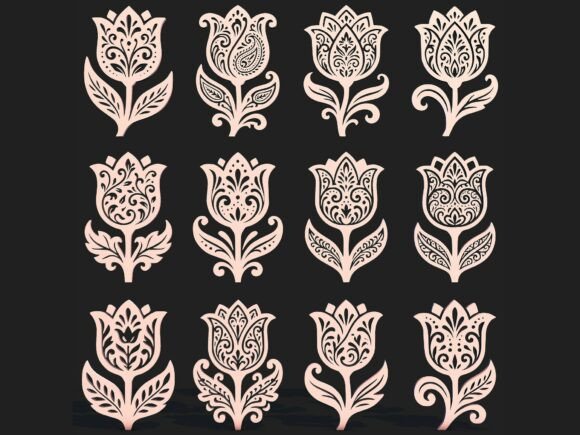
Tulip SVG STL Design Pack: Versatile Floral Art
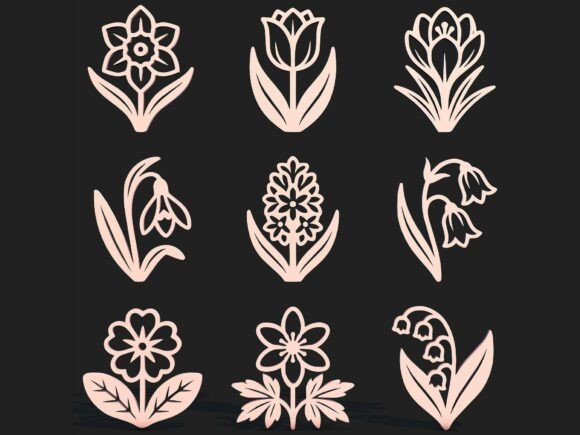
Floral motifs have long been a cornerstone of decorative arts, bridging the gap between natural beauty and structured design. Among these, the tulip stands out for its elegant curves and symmetrical form, making it an ideal subject for both two-dimensional crafting and three-dimensional modeling. The Tulip SVG STL Design Pack offers a comprehensive collection of twelve distinct patterns, crafted to serve a diverse range of creative workflows. Unlike single-format assets, this pack is engineered for maximum compatibility, ensuring that whether you are operating a laser cutter, a CNC machine, or a 3D printer, the files are ready for immediate use.
The versatility of this design library lies not just in the aesthetic quality of the petals and ornamental details, but in the breadth of technical formats provided. By including vector files like SVG alongside 3D models such as STL, OBJ, FBX, 3MF, and C4D, the pack eliminates the common friction of file conversion. This approach allows creators to focus on execution rather than troubleshooting software incompatibilities. Additionally, the inclusion of six high-resolution JPEG preview renders at 2500x2500 px and 300 DPI ensures that users can visualize the final outcome with precision before committing to physical production.
A Universal Tool for Diverse Creative Goals
The value of the Tulip SVG STL Design Pack shifts depending on who is using it. For a hobbyist looking to personalize home decor, the primary benefit is accessibility. For a professional manufacturer, the priority might be file integrity and scalability. Understanding these different perspectives helps clarify how this specific resource fits into various creative ecosystems.
For Beginners and Hobbyists: Lowering the Barrier to Entry
Newcomers to digital crafting often face a steep learning curve involving complex software and file management. The Tulip SVG STL Design Pack simplifies this process by providing "ready-to-use" assets. A beginner interested in laser cutting can import the SVG files directly into software like LightBurn or Silhouette Studio without needing advanced vector editing skills. The pre-designed nature of the twelve patterns means users do not need to spend hours drawing intricate floral lines from scratch.
Similarly, those exploring 3D printing for the first time can utilize the STL and 3MF files to create tangible wall art or decorative panels. The high-quality geometry of the tulip petals ensures that prints come out clean, reducing the frustration of failed prints due to poor mesh topology. For these users, the pack serves as an educational tool, demonstrating how digital designs translate into physical objects while delivering immediate, satisfying results.
For Professionals and Entrepreneurs: Efficiency and Scalability
Small business owners and freelancers operate under tight deadlines where reliability is paramount. In a commercial setting, the ability to scale a design without losing quality is critical. The SVG format within the pack ensures that tulip patterns can be resized from a small sticker to a massive architectural panel without pixelation. This scalability is essential for entrepreneurs producing custom signage, large-scale wall decor, or packaging elements.
Furthermore, the inclusion of multiple 3D formats (OBJ, FBX, C4D) allows professionals to integrate these designs into broader rendering pipelines. An architect or interior designer might use the C4D or FBX files to place realistic tulip motifs into a 3D room visualization for a client presentation. The 300 DPI JPEG previews provide a quick way to generate marketing materials or mood boards without needing to render the scene from scratch. For the business owner, this pack represents a cost-effective asset library that expands their service offerings without requiring in-house design teams.
For Educators and Makers: Teaching Digital Fabrication
In educational settings, the Tulip SVG STL Design Pack becomes a practical teaching aid. Instructors teaching courses on computer-aided manufacturing (CAM), 3D modeling, or graphic design can use these files to demonstrate specific techniques. For instance, an educator might assign a project where students must modify the SVG tulip paths to create a unique stencil pattern, thereby teaching vector manipulation skills.
Conversely, in a 3D printing class, the STL files can be used to discuss layer orientation, support structures, and material selection. Because the designs feature detailed botanical elements, they challenge students to think about how fine details survive the printing process. The variety of file formats also offers a lesson in digital interoperability, showing students how a single concept can exist across different software environments.
Technical Specifications and Workflow Integration
The true power of this design pack is found in its technical depth. Each file type serves a distinct purpose within a modern creative workflow, ensuring that no matter the hardware or software stack, the user has a compatible option.
- SVG Files: These are the backbone of 2D fabrication. They define shapes using mathematical equations, making them perfect for laser cutting, CNC carving, and vinyl cutting machines like Cricut and Silhouette. The clean lines of the tulip petals ensure precise cuts and minimal material waste.
- STL and 3MF Files: Standard formats for 3D printing. The STL files are widely supported by all slicing software, while the 3MF files offer enhanced color and texture data capabilities for more advanced printers. These are ideal for creating solid decorative objects, vases, or layered wall art.
- OBJ, FBX, and C4D Files: These formats cater to digital artists and modelers. They allow the tulip designs to be imported into 3D rendering engines like Blender, Maya, or Cinema 4D. Users can apply textures, lighting, and animations to the floral models for digital media, video games, or virtual reality projects.
Evaluating Quality and Usability
When evaluating a design pack, potential users should consider the balance between detail and usability. The Tulip SVG STL Design Pack strikes this balance by offering ornate floral details that remain functional. For example, the petal edges are defined clearly enough to be cut by a laser but smooth enough to look organic when printed in 3D. The inclusion of high-resolution JPEGs further aids in evaluation, allowing users to inspect the intricacies of the design before downloading or purchasing.
Reliability is another key factor. Inconsistent file formats can lead to errors during the production phase, costing time and money. By providing a suite of industry-standard formats, this pack minimizes the risk of compatibility issues. Whether the goal is to engrave a wooden plaque, carve a metal sign, or print a ceramic flower, the underlying geometry remains consistent and robust.
Matching the Pack to Your Project Needs
Determining if the Tulip SVG STL Design Pack aligns with your goals requires a clear understanding of your intended application. If your work involves flat, 2D applications such as stencils, decals, or laser-cut wood signs, the SVG files will be your primary asset. However, if you are venturing into volumetric design, sculpture, or product prototyping, the 3D models become the focal point.
For consumers looking to decorate their homes, the pack offers a DIY solution that feels bespoke. You can create a set of matching wall panels or a unique centerpiece that reflects personal taste. For marketers and bloggers, these assets can be used to create eye-catching graphics for social media or blog headers, leveraging the timeless appeal of botanical art.
Ultimately, the Tulip SVG STL Design Pack is more than a collection of files; it is a flexible toolkit designed to adapt to the user's skill level and project scope. From the casual crafter experimenting with a new hobby to the seasoned professional delivering high-end commissions, the combination of elegant design and technical versatility makes it a valuable resource for anyone working at the intersection of art and technology.