Evaluating the Vacation Travel 3D Icon Set for Modern Design Projects
In the competitive landscape of digital tourism and travel marketing, visual assets play a critical role in capturing user attention. The Vacation Travel 3D Icon Set represents a specific approach to this challenge, offering a collection designed to deliver a visual experience centered around vacation themes with a playful and modern aesthetic. For designers, product managers, and content creators aged 20 to 50 who are tasked with selecting the right graphical resources, understanding the nuances of this asset pack is essential. It is not merely a collection of images; it is a tool intended to create a relaxed, cheerful, and recognizable impression across various platforms.
When evaluating design resources, the decision often comes down to balancing artistic style, technical flexibility, and production efficiency. This article examines the characteristics of the Vacation Travel 3D Icon Set, compares it against alternative formats, and outlines the scenarios where it provides the most value. By analyzing its strengths and trade-offs, professionals can determine if this specific resource aligns with their project requirements or if another solution might be more appropriate.
Defining the Visual Identity and Style
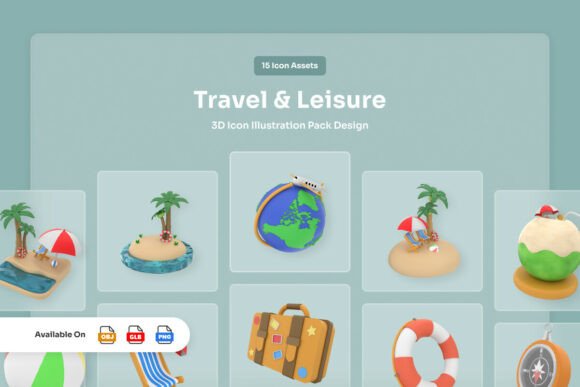
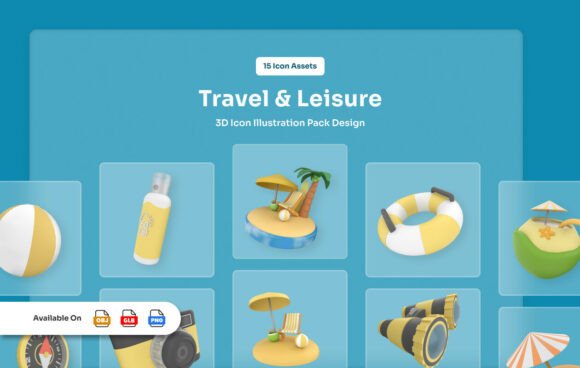
The core distinction of the Vacation Travel 3D Icon Set lies in its stylistic execution. Unlike flat vector graphics that rely on color blocking and minimal depth, or photorealistic renders that aim for indistinguishable accuracy, this set utilizes simplified yet expressive forms. The design philosophy prioritizes a "soft" 3D look, characterized by rounded edges, vibrant lighting, and a tactile quality that feels inviting rather than sterile.
This approach is particularly effective for tourism design and holiday campaigns. The human eye is naturally drawn to objects that appear tangible and friendly. The icons within this set are crafted to feel lively and memorable, avoiding the coldness often associated with corporate stock imagery. For a travel agency website or a mobile app promoting summer getaways, these elements help establish an immediate emotional connection. The playful nature of the icons suggests leisure and fun, which is often the primary selling point of vacation packages.
However, this distinct style also dictates its limitations. If a project requires a serious, ultra-minimalist, or strictly typographic interface, the whimsical nature of these 3D assets might clash with the overall brand identity. The decision to use them should hinge on whether the brand voice aligns with the "relaxed and cheerful" tone they convey.
Technical Flexibility and File Formats
A significant factor in choosing between different icon sets is the level of customization available. The Vacation Travel 3D Icon Set stands out by providing fully editable source files, specifically in Blender (.BLEND) format. This is a crucial advantage for designers who need to adapt assets to specific brand guidelines without starting from scratch.
- Blender Files (.BLEND): Allow for deep manipulation of geometry, materials, and lighting. Designers can change colors, adjust textures, or even modify the shape of the icons to better fit a unique layout.
- OBJ and GLB Files: These formats ensure compatibility with a wide range of 3D software and web technologies. GLB, in particular, is optimized for web usage, making it easier to integrate interactive 3D elements into websites without heavy loading times.
- High-Resolution PNGs (3000 x 3000 px): For teams that do not have access to 3D modeling software or need quick implementation, the included transparent PNGs offer a ready-to-use solution. The high resolution ensures crisp rendering on Retina displays and large-format print materials.
Compared to standard raster image packs that only offer fixed-resolution JPEGs or low-quality PNGs, the inclusion of editable 3D sources significantly extends the lifecycle of the asset. A designer can take a single beach umbrella icon and re-color it to match three different seasonal campaigns, whereas a static image would require purchasing multiple variations or commissioning custom work.
Comparative Analysis: 3D vs. Flat and Photorealistic
To make an informed decision, it is helpful to compare the Vacation Travel 3D Icon Set against other common design categories. Each style serves a different purpose and carries its own set of trade-offs.
Against Flat Vector Icons
Flat vector icons remain the industry standard for many UI/UX applications due to their scalability and clean lines. They load instantly and scale infinitely without quality loss. However, they often lack the depth and emotional resonance that 3D icons provide. In a crowded marketplace like travel, where users scroll through endless options, flat icons may blend into the background. The Vacation Travel 3D Icon Set offers a "pop" effect that can increase click-through rates and engagement. The trade-off is file size; 3D assets, even when rendered as PNGs, can be larger than simple SVG vectors, potentially impacting page load speeds if not optimized correctly.
Against Photorealistic Stock Photos
Photorealism has long been the go-to for travel marketing. High-quality photos of beaches and cities evoke a strong sense of place. Yet, they can be expensive to license, difficult to composite into cohesive designs, and sometimes feel generic. The Vacation Travel 3D Icon Set offers a middle ground. It retains the dimensionality of a photo but simplifies the subject matter into a stylized graphic. This allows for greater consistency across a design system. Instead of mixing five different photography styles, a brand can maintain a unified look using the 15 unique assets provided, ensuring a cohesive visual language throughout the campaign.
Against Custom 3D Modeling
Commissioning a 3D artist to create custom travel icons is an option, but it is time-consuming and costly. The Vacation Travel 3D Icon Set accelerates this process by providing pre-modeled, well-organized layers. While custom work offers total uniqueness, this asset set provides 90% of the desired outcome at a fraction of the cost and time. For agencies working under tight deadlines or limited budgets, this efficiency is a decisive factor.
Best-Fit Scenarios and Use Cases
Understanding when to deploy the Vacation Travel 3D Icon Set is just as important as understanding what it contains. Based on its characteristics, it excels in several specific environments.
Digital Content and Social Media: The vibrant and engaging nature of these icons makes them ideal for social media posts, Instagram stories, and email newsletters. The 3D effect captures attention in fast-scrolling feeds better than static 2D graphics. The transparent backgrounds allow for easy overlay on various colored banners or video content.
Holiday Campaigns and Landing Pages: For seasonal promotions, such as "Summer Sale" or "Winter Getaway," the playful aesthetic fits perfectly. The icons can serve as visual anchors on landing pages, guiding users toward call-to-action buttons without overwhelming the text content.
Mobile App Interfaces: Apps focused on booking, itinerary planning, or local discovery benefit from the tactile feel of 3D icons. They can make navigation feel more intuitive and enjoyable. The inclusion of GLB files suggests potential for interactive elements, such as icons that rotate when hovered over, adding a layer of delight to the user experience.
Limitations and Decision Factors
While the Vacation Travel 3D Icon Set is a robust resource, it is not a universal solution. Prospective users should consider the following limitations before committing.
Limited Asset Count: The set includes 15 unique 3D assets. For a comprehensive design system requiring dozens of specific symbols (e.g., every type of airport amenity or niche activity), this number may be insufficient. Users will likely need to supplement this set with other resources or customize the existing models heavily to create variations.
Software Dependency: To unlock the full potential of the editable features, proficiency with Blender is required. Teams without 3D modeling expertise will be limited to the provided PNGs. While the PNGs are high quality, they lack the infinite scalability of vector files or the dynamic lighting adjustments possible in a 3D environment.
Style Consistency: The "playful and modern" style is a double-edged sword. It works beautifully for leisure travel but may feel inappropriate for business travel, luxury cruises, or adventure tourism that aims for a rugged, serious tone. Evaluating the brand's current visual identity is a prerequisite for adoption.
Conclusion: Making the Right Choice
The Vacation Travel 3D Icon Set offers a compelling balance of aesthetic appeal and technical utility for those looking to inject vibrancy into their travel-related projects. Its strength lies in its ability to transform standard digital content into an engaging, memorable visual experience through simplified yet expressive 3D forms. For designers seeking to move beyond flat graphics without the overhead of custom 3D production, this set provides a practical and efficient alternative.
However, the decision to use this resource should be grounded in a clear understanding of project constraints. If the goal is rapid deployment with high visual impact and the team possesses basic 3D editing skills, the Vacation Travel 3D Icon Set is a strong candidate. Conversely, if the project demands extreme scalability, a vast library of specific icons, or a strictly minimalist aesthetic, exploring other alternatives may yield better results. Ultimately, the value of these assets is realized when they are applied thoughtfully to enhance the narrative of a travel brand, creating a cohesive and inviting atmosphere for the end user.